
Welcome to OK Glockenspiel, the definitive multimedia teaching method designed by OkMusic to turn classroom music lessons and home practice into an interactive, gamified learning experience. Featuring a seamless, teacher-approved pedagogical curve across 163 progressive tracks, this comprehensive online course helps students master the instrument from the very first note! 🎶
🎁 Start Instantly with Free Classroom Music Activities
No credit card required! Dive into our selection of free music activities directly on this web page to experience the OkMusic difference:
- Interactive Music Games for Kids 🕹️: Test note recognition and rhythmic reflexes instantly with our digital modules.
- Glockenspiel Sheet Music PDF Challenges 📝: Fun, downloadable and printable free music worksheets for young maestros.
- Premium Glockenspiel Backing Tracks 🎸: High-quality play-alongs that make practicing feel like playing in a real orchestra.
🔐 Unlock Premium Access & Official Certification 📜
Upgrade to the full glockenspiel music book course to explore easy glockenspiel songs (such as Ode to Joy and Jingle Bells), master complex music schemes of work, and download your official Diploma of Merit.
🚀 The Ultimate 3-Step Method: Ideal for Teaching Music Without Specialized Training
- 100% Teacher-Friendly 🏫: Perfect for teaching music without specialized training, providing structured music lesson plans for teachers.
- Engaging & Autonomous 👧: Clear, color-coded visual aids tailored for an inclusive primary school music curriculum allow kids to practice independently.
- Proven Learning System 🎯: Observe, Sing, and Play along with high-quality orchestral backing tracks to build steady glockenspiel notes for beginners.
🤝 Lifetime Support & Instant Access 💬
🛠️ Technique & Posture: Mastering the Instrument 🚀
Achieve a rich sound and optimal technique with these key guidelines, designed to enhance your glockenspiel mallet technique without strain:
- The Right Height 📏: Position the instrument so the bars are at belly level, ensuring relaxed arms and a natural, bouncy movement.
- The “Spring-Like” Grip 🖐️: Hold mallets gently to allow them to rebound naturally, producing a bright, open tone rather than a muted sound.
- Sticking (R and L) 👈👉: Follow the indicated right (R) and left (L) hand markings on the free glockenspiel sheet music to maintain smooth, fast playing.
🚀 The 3-Step Method: Structured Learning
Master your instrument and improve your rhythm games for kids with this progressive approach:
🧠 Step 1: Observe & Prepare
Analyze the sheet music first. Determine the starting hand and visualize the pattern to ensure accurate, confident rhythm.
🎼 Step 2: Sing the Music
Utilize this time for vocal development and ear training before playing:
- Follow along with the melody.
- Say the note names while maintaining a steady beat.
- Use the “🎧 Listen & Learn: Track with Guide Melody” files for pitch accuracy.
🎧 Step 3: Play with the Backing Track!
Apply your skills to full musical accompaniment, perfect for music resources for schools:
- Slow Start 🐢: Begin at a reduced tempo to ensure precise timing.
- Performance Speed 🏎️: Advance to full tempo, playing along with orchestral tracks to enhance musicality.
🎹 Find Your Melody Instantly! 🚀
Don’t waste time scrolling through the entire page! Click on the lesson or song number you want to practice today and jump straight to it: 1 – 2 – 3 – 4 – 5 – 6 – 7 – 8 – 9 – 10 – 11 – 12 – 13 – 14 – 15 – 16 – 17 – 18 – 19 – 20 – 21 – 22 – 23 – 24 – 25 – 26 – 27 – 28 – 29 – 30 – 31 – 32 – 33 – 34 – 35 – 36 – 37 – 38 – 39 – 40 – 41 – 42 – 43 – 44 – 45 – 46 – 47 – 48 – 49 – 50 – 51 – 52 – 53 – 54 – 55 – 56 – 57 – 58 – 59 – 60 – 61 – 62 – 63 – 64 – 65 – 66 – 67 – 68 – 69 – 70 – 71 – 72 – 73 – 74 – 75 – 76 – 77 – 78 – 79 – 80 – 81 – 82 – 83 – 84 – 85 – 86 – 87 – 88 – 89 – 90 – 91 – 92 – 93 – 94 – 95 – 96 – 97 – 98 – 99 – 100 – 101 – 102 – 103 – 104 – 105 – 106 – 107 – 108 – 109 – 110 – 111 – 112 – 113 – 114 – 115 – 116 – 117 – 118 – 119 – 120 – 121 – 122 – 123 – 124 – 125 – 126 – 127 – 128 – 129 – 130 – 131 – 132 – 133 – 134 – 135 –136 – 137 – 138 – 139 – 140 – 141 – 142 – 143 – 144 – 145 – 146 – 147 – 148 – 149 – 150 – 151 – 152 – 153 – 154 – 155 – 156 – 157 – 158 – 159 – 160 – 161 – 162 – 163
🎵 Track No. 1: The Song of “B” 🎶
The starting point of our musical journey is the note B. This exercise is fundamental because it allows you to focus immediately on tone quality and striking precision on the keys. 🌟
🔁 THE REPEAT SIGN: Let’s Play it Again! 🔄
The repeat sign invites you to play the section again to perfect your execution. ⏪✨ Repeat the music enclosed between the open and close dots. 👈👉 If you only see dots at the end of a section, go right back to the beginning of the track! 🚀
1. Where is it on the Staff? 🎼
The note B is located exactly on the 3rd line (the middle line). Every time you see a note on this line, you know you need to strike the corresponding key!
2. How to Play it on the Keys? 🔍

Look at the image on this page to identify the correct key. 🖼️ Verify your mallet positioning against the diagram to ensure absolute accuracy. 📏 Aim for the center: strike the middle of the key firmly but gently, letting the mallet rebound instantly to let the sound vibrate freely. ✨
3. Listen and Verify 👂
The sound must be clean and resonate openly. If it sounds muffled or choked, make sure you aren’t leaving the mallet head resting on the key after the strike! 🎶

🎧 Listen & Learn: Track with Guide Melody
🎸 Star on Stage: Orchestral Backing Track for Solos
🎵 Track No. 2: Here Comes “C”! 🎶
After mastering B, it is time to discover a new sound: the high C note. Expanding your range will allow you to play richer and more interesting melodies! 🌟
- 1. Where is it on the Staff? 🎼
Unlike B which sits on a line, C is located in the 3rd space of the staff (counting from the bottom). Learning to recognize it visually is the first step toward fluent reading! - 2. How to Play it on the Keys? 🔍

Identify the correct key using the graphic scheme above. 🖼️ Maintain an elastic wrist movement to make the key ring out with a crystal-clear tone. ✨ - 3. The Rhythm: The Whole Note (4 Beats) ⏳
In this track, we use the Whole Note 🅝: - Play for 4: Strike the note and let it vibrate while counting mentally “1, 2, 3, 4”. ⏱️
- Silence for 4: When you see the whole rest (the small rectangle hanging from the 4th line), stop all vibrations and stay silent for four beats. 🤫
- 💡 Educational Tip:
Switch between B (Activity 1) and C (Activity 2) by alternating your arms smoothly. Listen to the pitch difference: C is higher than B! 🎧🎵


🎧 Listen & Learn: Track with Guide Melody
🎸 Star on Stage: Orchestral Backing Track for Solos
🎵 Track No. 3: The Dialogue Between B and C 🎶
In this activity, you will combine everything you have learned. It is time to create a real musical dialogue on the keys, alternating precisely between B and C. 🎹✨
- 1. Alternating the Notes 🔄
Move the mallet between B (3rd line) and C (3rd space) while keeping your body relaxed. 🎯 Use the image on this page as a reference to memorize the distance between the two keys. 🖼️ Strike both notes with the same intensity for a balanced volume. - 2. Rhythm and Time Management ⏳
Each note and rest has a duration of 4 beats. ⏱️ Use the 4 beats of silence (the rest) to physically move your mallet and position it precisely over the next key. This ensures you always arrive on time for the next strike! 🤫 - 3. The Goal: Fluidity ✨
Do not rush. The goal is a clean, harmonious transition between the notes, without abrupt interruptions or hesitation. 🌈 - 💡 OkMusic Tip:
Before playing with the backing track, speak the note names out loud in time with the beat (“B – 2 – 3 – 4 | rest – 2 – 3 – 4 | C – 2 – 3 – 4…”). If you can say it, your hands will follow easily! 🎼🏆

🎧 Listen & Learn: Track with Guide Melody
🎸 Star on Stage: Orchestral Backing Track for Solos
✍️ STAFF CHALLENGE – B & C Mission! 🎼🎨
Test your sight and your hand! 🖐️ It is time to become a true music scribe with this written challenge. 🖋️📜 Reading and writing notes is the superpower that lets you decode any melody in the world! 🌍💎
Quick Recognition: Look at the written notes and write their names underneath. Can you do it faster than a computer? 💻⚡
Grab a black pen, warm up your hand, and master the staff! Great job, young maestro! 👨🎨👩🎨🎶
Your Creative Mission: 🎯🖍️
Draw the Notes: Place B accurately on the third line and C in the third space. Millimeter precision! 📏🎼
– Use the black pen to copy, in the empty measures, the same notes proposed in the previous measure and write their name –

🕹️ HEAD-TO-HEAD CHALLENGE: The B and C Duel! 🚀🎶
Ready for a speed challenge? ⏱️ In this interactive game, there are only two protagonists: B and high C! 🎼💎 It sounds easy, but can you stay focused without making mistakes? 🔥
- ⚡ Quick Reflexes: Watch the note appear on the screen and decide in a flash: is it a B or a C? 🧠💨
Have fun, and may the fastest musician win! 🎈🏆
🎵 Track No. 4: Cutting the Beat in Half! 🎶
In this activity, we consolidate our knowledge of B and C, but with a major update that will change the way you read sheet music and move on the keys! 🚀
1. The New Note Value: The Half Note ⏳
Until now, we used the Whole Note (4 beats). Now, the Half Note enters the game:
Half Note: Lasts for 2 beats. The sound is shorter, so you must be ready to strike the next key. ⏱️
Half Rest: Lasts for 2 beats of silence. It gives breathing room to the melody and prepares your next strike.
2. Watch the Symbols! (Whole Rest vs. Half Rest) 🧐
Learning to distinguish them visually is a milestone in your music training. Although they look similar, they sit on different positions on the staff:
Whole Rest (4 beats): A small rectangle “hanging” down from the 4th line. 🎩🔄
Half Rest (2 beats): A small rectangle sitting “on top” of the 3rd line. 🎩
3. Attention: No Repeat Sign! 🚫🔁
Unlike previous activities, there are no repeat dots in this sheet music. Play the track from start to finish only once. 🏁 Stay focused: once the last note is struck and the last rest is respected, your performance is complete!
4. Technique and Precision ✨
Faster rhythms require better wrist control. Keep your touch elastic and bouncing, making sure every 2-beat note maintains a balanced volume. 🌈
💡 OkMusic Tip:
During Step 2 of the method, count the Half Notes out loud like this: “B – two, C – two”. This verbal rhythm prevents rushing and gives each note its full two beats! 🎼🏆

🎧 Listen & Learn: Track with Guide Melody
🎸 Star on Stage: Orchestral Backing Track for Solos
🎹 Track No. 5: Become a Half Note Master! 🎶
Welcome to the fifth step of the OkMusic method! 🌟 Before exploring new territories on the staff, it is crucial to halt for a moment to become true champions with the notes and rhythms already studied. Track No. 5 is your “musical gym” to strengthen visual memory and striking precision on the keys.
- 🎼 Lesson Elements: Mastering the Basics
In this track, we do not add new elements, but we train your ability to play with confidence:- Active Key Review 🎶: Test your speed in recognizing the notes learned so far. Pass from one key to another without hesitation, memorizing the physical distance between B and C.
- Striking Precision 🎯: Focus on tone clarity. Strike the exact center of each key with an elastic wrist movement to get a crisp attack, avoiding choking the natural vibration of the instrument.
- Rhythm Control ⏳: The Half Note requires a steady sense of time. Ensure each note lasts exactly two beats, keeping a constant sound intensity.
- ✨ The Goal: Fluidity and Confidence 🏆
Playing these sequences smoothly without constantly staring at the keys—relying instead on reading the sheet music—is the sign that you are ready for the next challenges. 🚀 - 💡 OkMusic Tip:
Listen closely to the resonance: if the sound is too choked, make sure your mallet rebounds instantly after the touch. The key must be free to sing! 🎼🎹

🎧 Listen & Learn: Track with Guide Melody
🎸 Star on Stage: Orchestral Backing Track for Solos
🎈 Track No. 6: Touching the Sky with Note D!
Welcome to the realm of high D! This note has a bright and crystal-clear sound, perfect for adding light to your first melodies. 🌟
- 1. Where is it on the Staff? 🎼
The note D is located exactly on the 4th line (counting from the bottom). Visually, it is one step above the B note. Spotting it quickly helps you move with agility on the keys! - 2. How to Play it on the Keys? 🔍
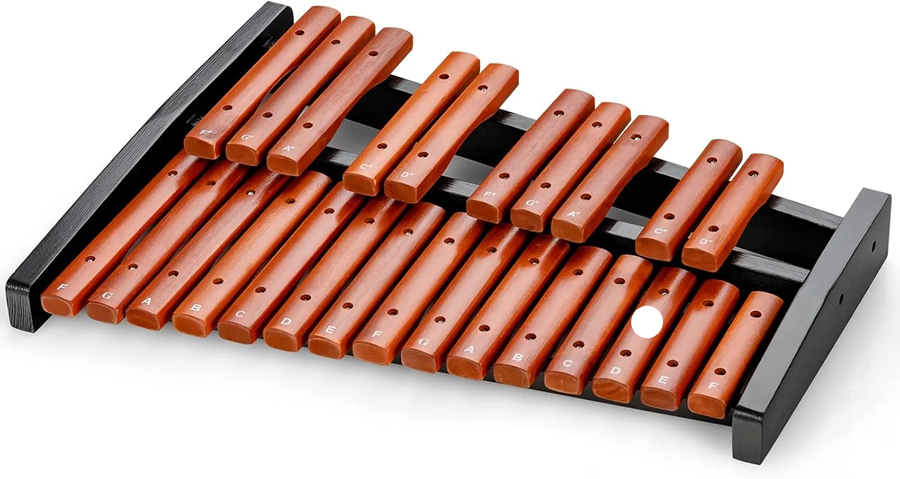
- Observe the image: Identify the correct key by checking the graphic diagram above. 🖼️
- Find the position: Locate the corresponding bar on your instrument. You will notice it sits right after the C key. 📏
- Striking precision: Being a higher note, it requires a very precise touch. Aim for the exact center of the key for a pure vibration. ✨
- 3. Listen to the Difference 👂
Strike the key and listen: high D has a very clear and audible timbre. Do not block the mallet on the surface; a fast rebound allows the note to “sing” without cutting out early. 🎶 - 4. The Goal: Agility in Leaps 🚀
Moving from C (3rd space) to D (4th line) is an excellent exercise for your precision. Even though the keys are close, practice shifting your hand smoothly to maintain a steady tempo, especially when using Half Notes. - 💡 OkMusic Tip:
Alternate slowly between C and D. Listen to how the “color” of the sound changes between these two adjacent notes. Once you feel confident, try playing the full song along with the backing track! 🎼🏆

🎧 Listen & Learn: Track with Guide Melody
🎸 Star on Stage: Orchestral Backing Track for Solos
🎹 Track No. 7: Become a Master of Notes B, C, and D! 🎶
You have reached a crucial milestone in your musical journey! ✨ In this series of tracks, we will not introduce new notes. Instead, we will focus on something even more important: becoming incredibly fast and precise with the positions we have already explored on the keys.
🎼 Your “Musician’s Kit” for This Step:

The following content is free but reserved for OkMusic members.
To access the activities, you must first register for free on the site (click here) and then log in (click here).
🏁 CONGRATULATIONS! 🎉
You have officially completed all 163 steps of your musical journey! This is a monumental milestone! 🏆✨
Throughout this complete path, you have learned to:
- Master mallet technique 🔨: Playing with alternating hands with total precision and fluidity.
- Read complex rhythms ⏱️: Managing note values perfectly, from whole notes to fast eighth notes.
- Handle accidentals 🎼: Navigating sharps (♯), flats (♭), and naturals (♮) smoothly across the keys.
- Perform masterpieces 🎹: Interpreting the greatest melodies in music history.
You have proven that music is not just about notes, but also about passion and perseverance. Your instrument is now your ultimate ally to explore any musical repertoire you desire! 🎶
📜 DIPLOMA OF MERIT OF XILOPHONE MASTER
You are now ready to receive your official Certificate of Merit! This document certifies your talent and your dedication. Print it out 🖨️, sign it ✍️, and hang it up with pride: you are now a true musician! 🌟
Bravo, Maestro! May music always be by your side! 🎈🎹🎷🌟
– 📥 Download my diploma –
📱 Let’s Stay in Touch: Support & Community by OkMusic! ✨
For any support, we recommend reaching out to us via:
🟢 WhatsApp: Chat with us directly by clicking here.
💬 Live Chat: Available in real time on every page of our website.
📧 E-mail: Send us a message at info.en@okmusic.it.

Follow us on Facebook! 👍
Like our page to stay updated and never miss lesson ideas, tips, and free resources for your music classroom!

The OkMusic YouTube Channel! 🎬
Subscribe and hit the bell icon to get instant access to new video tutorials, rhythm exercises, and exclusive previews!